
Origins and Development
Picture the late 1960s car scene: chrome, horsepower, and an unquenchable thirst for speed. The 1969 Pontiac Firebird Trans Am burst onto this scene like a rock anthem, born to challenge its rivals. It was the underdog with muscle to spare, dreamed up by Pontiac to outperform their own kin, the Chevrolet Camaro.
John Z. DeLorean, Pontiac's maestro, orchestrated this muscle symphony with a singular vision: superiority. While Chevrolet's Camaro flexed its muscles, Pontiac was fine-tuning its own champion under the hood.
Pontiac engineers didn't just drop a big engine in there—it was a ballet of mechanical innovation. The Trans Am boasted the Ram Air III and the Ram Air IV engines, refined high-output V8 monsters hidden beneath glistening white hoods with signature dual stripes.
The 1969 Trans Am needed the swagger to match its roar. All cars came in Polar White with striking blue racing stripes—a nod to the track, and perhaps a middle finger to subtler competitors. The looks were punctuated by a distinct hood and a rear spoiler, cleverly designed to catch both the eye and the wind.
Handling was crucial too. Suspension set-ups featured:
- A beefy front stabilizer bar
- Variable-ratio power steering
- Larger Polyglas tires
All geared for anchoring this livewire through the curves.
Pontiac faced challenges. The market was evolving, with Ford's Mustang and the Camaro leading the charge. Instead of playing it safe, they rolled the dice on creativity and performance. Purists grumbled about the Trans Am name, but Pontiac maneuvered like chess players, even striking a deal with SCCA to use it.
Those April 1969 days didn't bring instant sales success. But the audacity of the Firebird Trans Am, its raw power and aggression, secured its place in car culture legend. It was more than just a car; it was a testament to the spirit of an era.
Engine and Performance
The beating hearts of the '69 Trans Am, the Ram Air III and IV, were thunderous declarations of power. Under the hood lurked the mythical 400 cubic-inch V8 engines, each yearning to flex its muscle on the open road.
The Ram Air III was no slouch, with 335 horsepower and 430 lb-ft of torque. It pinned you to your seat, launching this beast down the asphalt to a quarter-mile in 13.9 seconds.
Then we have the Ram Air IV—Pontiac's heavy hitter. It didn't just enter a room; it owned it, producing 345 horsepower and matching its sibling with 430 lb-ft of torque. When it blasted through the quarter-mile in 13.7 seconds, you could almost hear it mocking other muscle cars, daring them to catch up.
Stack the Ram Air IV against the competition:
| Model | Horsepower |
|---|---|
| Ram Air IV | 345 hp |
| SS 396 | 375 hp |
| 428 Cobra Jet Mach 1 | 335 hp |
What set these engines apart was their high-revving nature. The Ram Air IV's aluminum intake manifold and refined internals offered not just a sprint, but a nirvana-fueled marathon of longevity and performance. These engines were built to conquer straight lines and command corners, backed by componentry that spelled out "go fast" in bold letters.
Pontiac didn't just join the muscle car wars—they started a revolution. The 1969 Firebird Trans Am's Ram Air engines were both the battle cry and the victory, leaving a legacy of beautifully brutal performance for future gearheads to drool over.

Design and Features
The 1969 Pontiac Firebird Trans Am is all about the details, and those details are anything but subtle. If the engines were the soul, the design was the attitude. And what an attitude it was.
Let's talk about that paint job—Polar White, as if the gods themselves had touched each Trans Am with the icy hand of cool. Those Lucerne Blue racing stripes carved through the car's landscape, declaring prowess from every angle.
And those hood scoops? Sitting there like catapults, ready to launch you into the stratosphere. They weren't just for show—they funneled cool air directly into the heart of the Trans Am, keeping those ponies chilled and ready to stampede at the tap of the throttle.
The rear spoiler stretched 60 inches of fiberglass glory across the backside. It wasn't just about looks; it kept the rear end planted around corners at high speed, like an ace pilot leveling a plane in turbulence.
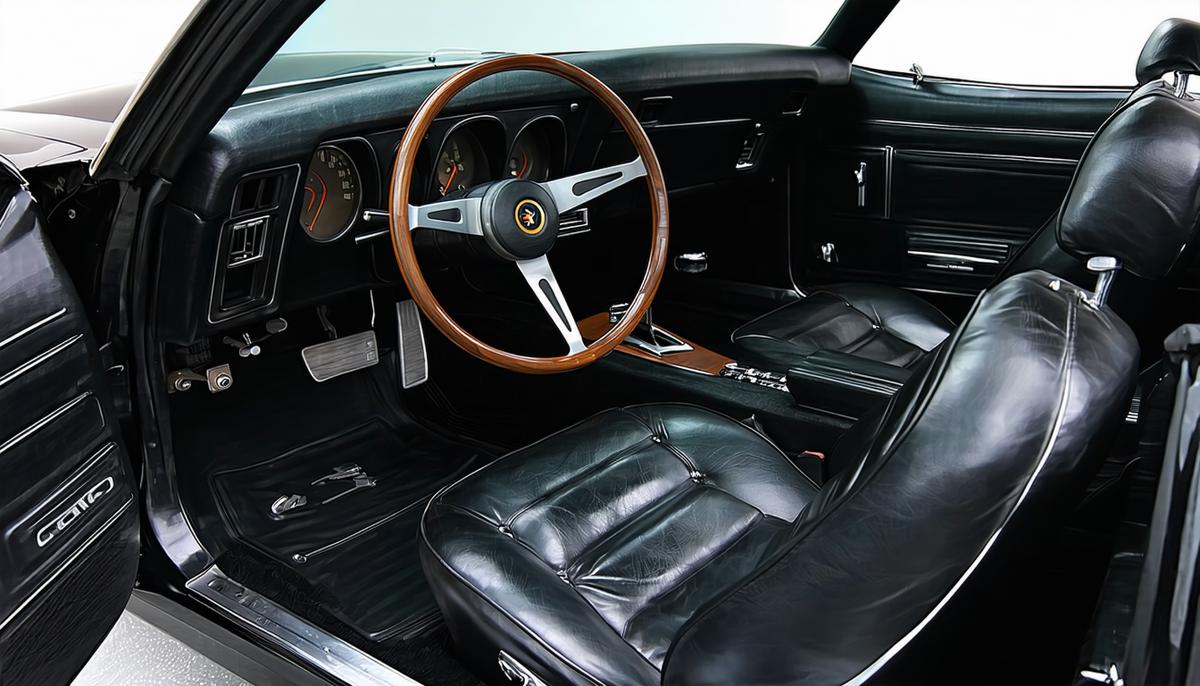
Step inside, and you're in a cockpit designed for the fast lane. Those bucket seats envelop you in a world of purpose-built simplicity. Everything you need is exactly where you want it, making you feel less like a driver and more like a fighter pilot ready for takeoff.
"The steering wheel communicated with your palms, telling you precisely where those wheels were pointed."
Even the dash was engineered for clarity, a commander's console informing you of your imminent victory in whatever race you chose for the day.
High-effort variable ratio power steering meant you weren't just turning a wheel; you were dancing with the road. And those Polyglas F70x14s on seven-inch rims? They gripped the pavement like a gladiator's sandals on Roman stone, ready for combat at a moment's notice.
Together, these elements crafted a silhouette that carved its name into motoring legend. The 1969 Firebird Trans Am wasn't just a collection of parts; it was a holistic masterpiece unleashed by Pontiac, wrapped in a package that could only be described as a feast for the senses and a nightmare for any rival brave enough to take the challenge.
Production and Rarity
The 1969 Pontiac Firebird Trans Am wasn't just rolled off the assembly line—it was sculpted with the seal of rarefied grandeur. We're talking exceptional numbers here—only 697 coupes and a mere eight convertibles hit the streets. That's a drop in the bucket compared to the thousands of muscle cars manufactured during the golden era of horsepower.
But why such a limited run? The Trans Am debuted smack in the middle of a muscle car arms race, competing not only against external rivals but also internal ones like the Chevy Camaro. Pontiac wanted this vehicle to be a showpiece—a jaw-dropping symbol of their capabilities. They aimed to spark envy and awe rather than flood the streets.
Factors contributing to low production:
- Funding shortages
- Timing woes
- Late March 1969 launch
- Costly performance and appearance package
In today's world of car collecting, rarity plus desirability equals value. The 1969 Firebird Trans Am sits on a pedestal because of its scarcity. That sheer lack of numbers gives it an ethereal quality, making it the object of adoration for aficionados seeking a piece of motoring history.
And those eight convertibles? They're the unicorns of the car-collecting kingdom. So rare you'd need a map and compass to find one. These convertibles hold a place of coveted honor among collectors, often fetching prices that suggest they were built with platinum and dreams.
The 1969 Firebird Trans Am's rarity isn't just a number—it's a legend that attracts romantics and realists alike. It's the whispered ghost at car shows, the signature in a room buzzing with signatures. If you've got one in your garage, consider yourself part of a select club—one where the doors of history revel in your humble brag.

Legacy and Impact
The 1969 Firebird Trans Am didn't just fade into obscurity. It blazed its own trail, leaving a legacy etched in muscle car history.
This beast wasn't just a product of its time; it was a game-changer. It redefined what was possible for Pontiac and the entire muscle car genre. Though rare on the roads, its influence has amplified through the decades, echoing in every American muscle car that followed.
The Firebird Trans Am became Pontiac's performance flagship almost overnight, dethroning the GTO. Its success sparked a series of increasingly powerful and stylish Trans Am models. They became stars in their own right, burning rubber on the silver screen in "Smokey and the Bandit" and embodying cultural icons like "The Bandit."
The fire it started lit up the path for future generations. The Trans Am kept evolving, hitting pivotal moments in pop culture—like in "Knight Rider," where the 1982 model, as KITT, became an undeniable icon. Each iteration carried that original Trans Am DNA—never backing down, always pushing boundaries. It became a symbol of freedom, adrenaline, and the relentless pursuit of power.
Industry-Wide Impact
The '69 Trans Am's influence spread beyond Pontiac, casting a long shadow over the entire industry. It showed that style and speed could coexist in harmony. Automakers took note, realizing the appeal of marrying cutting-edge engineering with aggressive designs. You can still see its influence in the bold curves of modern performance vehicles—each one a nod to those early racing stripes.
In a time when cars were becoming cultural artifacts, the '69 Trans Am established itself as both a rebel and a phenomenon. It reshaped American car culture, daring enthusiasts to dream bigger and carmakers to turn those dreams into reality.
The Trans Am will always stand as a shining example of the muscle car zenith, a tribute to an era of unbridled power, chrome fantasy, and the sweet symphony of V8 roars.
Its legacy doesn't just rest on laurels—it roars through history, demanding respect every time a gearhead pushes those RPMs into the red. Let's not just remember it—let's celebrate it!

In the pantheon of automotive legends, the 1969 Pontiac Firebird Trans Am stands as a testament to an era defined by boldness and raw power. It wasn't just a car; it was a declaration of intent, a roaring embodiment of muscle and spirit that continues to inspire and captivate. As we reflect on its legacy, we are reminded of the indelible mark it left on car culture, forever echoing in the hearts of enthusiasts who crave the thrill of speed and the allure of timeless design.