
If you thought 350-kW fast charging was the top of the mountain, it’s time to look again. The Society of Automotive Engineers (SAE) just dropped the J3400/2 standard — a technical milestone that quietly pushes EV charging into a whole new league: 1,000-volt, 1,000-kilowatt megawatt-class power.
That’s not just a number. It’s the tech foundation that makes 5-minute EV top-ups a real possibility down the road — if the hardware can catch up.
What Is SAE J3400/2, in Plain English?
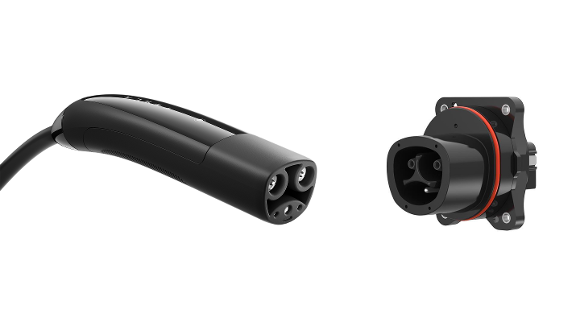
J3400/2 is the newest standard in a family of specs focused on the North American Charging Standard (NACS) — Tesla’s formerly proprietary plug that’s now being adopted across the U.S. EV industry. This latest installment locks in the physical and safety requirements for megawatt-class DC fast charging.
Translation: It gives automakers and charger companies a single blueprint for how to safely build ultra-high-power systems that talk to each other — no more guessing on port shapes or cable clearances.
According to SAE, this includes 2D drawings and 3D models of plug geometry and port layout — especially crucial at 1,000 volts, where higher voltages demand more spacing between terminals to avoid dangerous “creepage” (when electricity arcs through air or across surfaces).
Why Now?
Tesla’s plug design always technically supported this kind of futureproofing — the Cybertruck was the first to ship with 1,000V readiness — but without an official standard, other companies had no roadmap for adopting it. That led to weird problems, like CCS-to-NACS adapters that only worked if you removed your wheel-arch trim.
Now, the specs are public. Third-party charger makers and OEMs have the clear specs they need to build interoperable equipment — and make sure it fits your car without a YouTube tutorial and a screwdriver.
Will You Actually See 1,000 kW Chargers Soon?
Not likely. Right now, 350 kW is the peak on U.S. highways. But in China, megawatt-capable cars and chargers are already being sold. BYD’s Super e-Platform supports 1,000V at 1,000 amps — that’s a theoretical 10C charge rate, which could add 250 miles in under 5 minutes.
Battery health is still a concern, and there’s no consensus on how existing lithium-ion chemistries handle such extreme charge speeds. That’s where the promise of solid-state batteries could come in, offering both speed and longevity.
The Real Win: Compatibility
You don’t need a 1MW charger in your driveway to benefit from J3400/2. The standard ensures that even if your EV tops out at 400V, it’ll still work with a high-power charger — safely and reliably. Think of it like USB-C for EVs: same plug, smarter power handling under the hood.
Plus, with the standard baked into public documents, vendors and startups can innovate on charging hardware without running into fitment issues or electrical hazards. And that means more competition — and eventually, lower costs.
TL;DR
- SAE J3400/2 is the new fast-charging standard for EVs, enabling 1,000-volt, 1,000-kW (megawatt) charging.
- It makes Tesla’s NACS plug the universal blueprint for North America, backed by official specs.
- You won’t see 1MW chargers at rest stops yet — but the groundwork is now in place.
- Cybertruck is already 1,000V-ready, and now other automakers can safely follow.
- It’s a big step toward 5-minute EV charging, once batteries and infrastructure catch up.